Curated collection
Mathematics for programmers
Free books on discrete mathematics, linear algebra, probability, statistics and the math that makes computer science click.
You can write software without much mathematics, but the ceiling arrives quickly. Discrete mathematics explains graphs, logic and proof; linear algebra explains graphics, machine learning and signal processing; probability and statistics explain uncertainty, testing and data analysis.
This collection is for developers who want to fill those gaps without enrolling in a degree. The books range from gentle introductions to rigorous course texts. Start with discrete mathematics if you want a foundation for algorithms, then choose linear algebra or probability depending on what you are building.
FreeTechBooks records the publication year and license for every title. Older editions are often still useful, especially for foundational material.
-
01
Topoi: The Categorial Analysis of Logic
A classic exposition of a branch of mathematical logic that uses category theory.
-
02
An Introduction to the Theory of Computation
This book explores terminologies and questions concerning programs, computers, problems, and computation. The exploration reduces in many cases to a study of mathematical theories, such as those of automata and…
-
03
A Short Course in Discrete Mathematics
The first part of the two series of book, used to teach discrete mathematics that includes Boolean arithmetic, combinatorics, elementary logic, induction, graph theory and finite probability in the University…
-
04
Basic Concepts of Mathematics
Helps the student complete the transition from purely manipulative to rigorous mathematics.
-
05
Calculus
This book is a useful resource for educators and self-learners alike. It is well organized, covers single variable and multivariable calculus in depth, and is rich with applications.
-
06
College Algebra – Version [π] Corrected Edition
An introductory text for a college algebra survey course. The material is presented at a level intended to prepare students for Calculus while also giving them relevant mathematical skills that…
-
07
Discrete Mathematics
This book discusses a number of selected results and methods on discrete mathematics, mostly from the areas of combinatorics, graph theory, and combinatorial geometry, with a little elementary number theory.
-
08
Theory of Statistics
This document originated from lecture notes of mathematical statistics course taught at George Mason University. Students should be able to work through the details of "hard" proofs and derivations.
-
09
Graph Theory With Applications
An introduction to graph theory. Presents the basic material, together with a wide variety of applications, both to other branches of mathematics and to real-world problems. Several good algorithms are…
-
10
Advanced Calculus, Revised Edition
This book divides roughly into a first half which develops the calculus (principally the differential calculus) in the setting of normed vector spaces, and a second half which deals with…
-
11
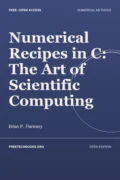
Numerical Recipes in C: The Art of Scientific Computing
Combines general discussion, analytical mathematics, algorithmics, and actual working programs. That is, a cookbook on numerical computation.
-
12
A First Course in Linear Algebra (Version 3.50)
An introductory textbook of linear algebra. Teaches the fundamental concepts and techniques of matrix algebra and abstract vector spaces.
-
13
A Computational Introduction to Number Theory and Algebra
Provides an introduction to number theory and algebra, with an emphasis on algorithms and applications.
-
14
Algorithm and Complexity
Methods for solving problems on computers and the costs (usually the running time) of using those methods.
-
15
Yet Another Introductory Number Theory Textbook (Cryptology Emphasis Version)
An introduction to number theory covering basics, congruences, primes, the Chinese Remainder Theorem, Wilson's Theorem, Fermat's Little Theorem, Euler's Phi function, etc.
-
16
Lies, Damned Lies, or Statistics: How to Tell the Truth with Statistics
A free textbook for a one-semester, undergraduate statistics course. The goal of this book is to help you learn How to Tell the Truth with Statistics and, therefore, how to…